
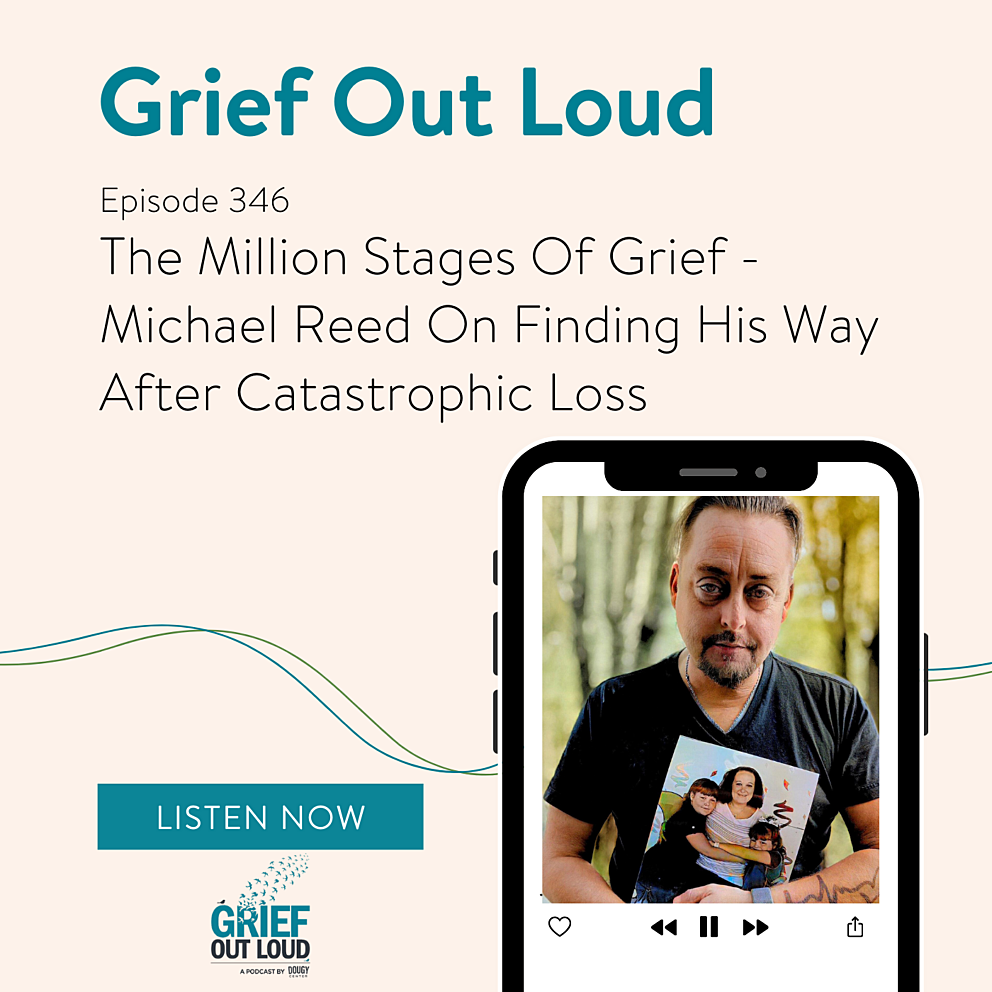
This is the transcript for Grief Out Loud Ep. 346 The Million Stages Of Grief - Michael Reed On Finding His Own Way After Catastrophic Loss. Find the audio version of the episode here.
Ep. 346 Transcript: The Million Stages Of Grief - Michael Reed On Finding His Own Way After Catastrophic Loss
SPEAKERS
Jana DeCristofaro (host)
Michael Reed (guest)
Jana DeCristofaro:
Hey listeners, it’s Jana. Welcome back to Grief Out Loud.
I don’t know if it’s objectively true, but it seems like we are seeing many more wildfires, across the world, causing large scale damage – to property, to livestock, and in the most heartbreaking ones, taking people’s lives. Here on the west coast, it’s hard to travel anywhere over the mountains without seeing evidence of these fires – blackened trees, whole towns in the midst of being rebuilt, and memorials to those who didn’t survive. For Michael Reed, this kind of tragedy literally came home on the night of November 28th, 2016. That night Michael lost his wife Constance, his daughters Chloe and Lily, his home, his pets, and nearly every physical trace of the life they had built together.
In the days and weeks that followed, Michael describes being catatonic — moving through the world without really being in it, unable to remember where he went or how he functioned. Nearly ten years later, Michael is still grieving. He'll tell you that plainly. But he's also doing something with that grief — writing about it, talking about it, and connecting with people around the world who have felt just as alone and mired in darkness as he once did.
His book, The Million Stages of Grief, started as something he wrote for himself — a way of tracking where he was emotionally. But thanks to the response he got from posting a piece on Facebook, he moved forward with publishing it for others to read.
In our conversation today, Michael talks about his girls – Constance, Chloe, and Lily and specific and irreplaceable ways they moved through the world. He talks about the particular grief of losing your home alongside the people you love, and what it means to keep someone's memory alive when you have almost nothing tangible left to hold. He talks about watching his son Nicholas grieve the same loss, but differently. And he talks honestly about his years-long battle with his faith and God and what’s helped him return to both.
In true Grief Out Loud fashion, this is a conversation about what grief actually looks like — not the tidy, linear version, but the real one, with its a million different stages that sometimes occur all in a single day.
Quick note – there's some pretty salty language in this episode, so if you’re not into that, maybe skip this one.
Okay here’s our conversation.
Jana:
Welcome to Grief Out Loud, Michael. Tell us a little bit about your girls — Constance, Chloe, and Lily.
Michael:
They're my world. To me, they're still here, so I don't refer to them in the past tense. Constance is my best friend, my soulmate. I knew the second I met her. After the first night we met, I called my dad and said, "I just met my wife." And he said, "You're nuts." I found out later that when she went home, she told her stepdad, "I just met my husband" — and I'm sure he thought she was nuts too. But we knew it. We knew it the instant we met.
We have a son, Nicholas, who's 24 now — all grown up and on his own. And then there's my girls. Chloe is forever 12. Lily is forever nine. Chloe's my princess, and Lily is my diva. I miss them so much.
Chloe had the kindest heart I've ever known. You know, when we lose somebody, there are unanswered questions — but there are also moments where you discover a compassion in them you didn't even know was there. One day, Chloe's teacher was having a bad day at school. Chloe came home and didn't say a word to me about it. This was maybe a month before the fires.
After the fires, that teacher came up to me and said, "Mr. Reed, one day I told the class I was having a bad day. The next morning, Chloe came into class and handed me her favorite ladybug stuffed animal. She said, 'This is what helps me when I'm not feeling good. I wanted to help you.'" That stuffed animal is all I have of Chloe now. But it's a symbol of her heart. She was the best of all of us.
Lily — when I tell you that girl had sass. I'm talking the hand on the hip, snapping her fingers. She couldn't say the word "jerk" when she was little — she'd say "jut." She'd come out for school in some ridiculous outfit she knew I wouldn't let her wear in public, just to get a rise out of me. I'd say, "Get your booty back in there and change your clothes." And she'd go, "You're such a jut!" — slam the door — and then come back out in normal clothes. Oh, she was something.
Twelve and nine is too young. But over the years I've learned that even though they're gone, I still got twelve years and nine years. That's a lifetime of memories, and I carry every single one of them with me every day.
Jana:
One thing that stands out to me is that when someone in our life dies and our home is impacted — whether from a flood, a fire, a tornado, or a hurricane — we often lose all the tangible reminders of the people we've loved. You have that ladybug stuffed animal because Chloe had given it to her teacher before the fires, before they died. What has it been like to keep those memories close without having the physical items?
Michael:
I've always wondered — if it hadn't been a wildfire, if it had been a car accident or something — would I have been able to live in that house without them? And no, I wouldn't have. When I lost everything that night, I literally lost everything.
There's so much I still haven't processed. I've never processed losing our home. I've never processed losing our pets. I've never processed losing all the pictures on the walls. I can only get to a certain point, and then it stops.
It's very scary when you have nothing. I didn't even have a toothbrush. My son was fifteen that night — his PlayStation, his Game Boy — gone. Where do you start? I don't even know where I started. I was absolutely catatonic for the first six months. I don't remember anything. I don't remember where I went or what I did. I don't remember getting another house.
I think my brain has tried, over the years, to protect me from the pain — even though my heart still feels it every day.
Jana:
What are some of the ways you think your brain has tried to protect you?
Michael:
It's helped me, and it's also been my worst enemy. I have really bad PTSD, anxiety, and depression. When the wind starts blowing hard, I turn into a ten-year-old. For a long time, I was convinced another wildfire was coming, so I was very guarded.
But my brain still lets me remember little pieces. When we're traumatized, it's like somebody takes your brain, squishes it all around, and shoves it back in — and it's our job to try to put it back together. What I've put back together is nothing like I used to be, but my heart is still the same. I love my girls unconditionally.
For a long time, I thought they were on vacation. I was absolutely convinced they'd come back tomorrow. I thought the house was still there and all I had to do was go home and they'd be there. I went once, and I sat in the ash for hours just looking for something I could hold.
At one point I said to my dad, "Why are we here?" He said, "We're here until you're ready to go." I said, "I'm ready to go."
What my brain has taught me is that the tangibles around you don't matter. This phone doesn't matter. These are things that, if something happens, can be replaced. I just want to hold my girls again. That's all I want. And the only way I can hold them is through their spirit. So I've somehow been able to open my eyes enough to receive signs from them all the time.
Jana:
What's a recent sign that came through to you?
Michael:
Lily comes to me the most. She comes to me as an owl. I'm obsessed with HGTV's House Hunters — we've probably watched every episode five times. We'd sit there and just rip on the people looking at houses. "You can paint the wall, lady. Don't not get the house because the wall is the wrong color!"
In almost every episode, there's a sign. Yesterday's episode had an owl in the background. And I said, "Yep, there's Lily." I know that's not my daughter — but that's my daughter. That's just a little tug from heaven saying, "Daddy, I love you. Keep going."
When we lose somebody, that's the hardest thing to do — keep going. But it is the one thing they want us to do the most. So when I smile, I smile for them. When I meet a stranger who tells me their story and I give them a hug, that's not just me hugging them — that's all of us hugging that person. I try to live every day to make them proud. I fail a lot. There are days I can't stop crying. But I've never heard them say, "Dad, why are you having a bad day?" All I've ever heard is, "We love you. No matter what."
Jana:
You mentioned that you don't even really remember those first couple of months after the fires, after your wife and your two daughters died. What was it like trying to be there for your son, Nicholas — and who stepped in to help?
Michael:
My sister. I was a shell. She held me up, and she was so helpful to Nicholas. They're so bonded today — it's unreal. He'll listen to her before he'll listen to me. Go figure. I was useless. She stepped up and filled the roles of both my dad and my mom. I wouldn't be here without them.
Jana:
In watching your son grieve for his mother and his sisters, what have you learned about teens and grief?
Michael:
Grief is different for everyone. We lost the same people, but we lost different people at the same time. I lost a wife and daughters. He lost a mom and sisters. Children somehow have this magical ability to grieve better than adults do — to accept things and adapt more quickly.
It took him a few years, but one day Nicholas said, "Dad, I just want you to know — I've kind of processed everything. I understand, and I'm going to be okay." And I was mad at him. But in the exact same moment, he was my hero. Because he was at a place I was still trying to reach. I wasn't mad that he made it there first — I was just still in so much darkness. But he really set a good example for me.
Jana:
That seems so apt — to feel flabbergasted, maybe a little angry, but also inspired at how he was processing things.
Michael:
Exactly. And in the back of my head when he said that, it gave me just a little bit of hope that one day I could get there too.
I've spent the last two years in EMDR therapy, and I cannot begin to tell you how much it has helped. I'm in a season now where — I don't like the word "acceptance" — but I'm in a place where I understand that this loss is part of my identity. If you want to know me, you have to know them too. My purpose on earth now is to always talk about them, share the good memories and the happy times. I can feel them pushing me in directions and guiding me, and I will never let that go.
Jana:
There's a big difference between accepting the death and accepting that the people we lose continue to have a role in our lives — and that the loss has shaped us. That's a very different type of acceptance.
Jana:
I wonder if we could go back for a moment. You mentioned the stages of grief — we've talked a lot on the show about how they were originally designed for people who were dying, and have since been applied to people who are grieving. Your book, published in 2025, is called The Million Stages of Grief — and it's clearly about how the five stages didn't work for you. Can you talk about how you got there?
Michael:
For years, I would wake up in the middle of the night and just start writing — what I was thinking, what I was feeling. I did it mostly for myself, so I could look back in six months and ask, "Okay, this is how I feel today. How did I feel last year? Six months ago?" Just to see if I was making any progress. The answer was always no — I was still in the same place.
One day, I took something I'd written and posted it on Facebook. It was raw, unedited, real, authentic, and painful. That's what grief is. I just put it out there, and the response was overwhelming. People were saying, "I lost my mom ten years ago and I was thinking the exact same things. Finally it makes sense. Thank you for these words." I was stunned.
A month later I posted another piece. Then it became a blog. Then people started saying, "Please write a book." I never knew where to start, but eventually I just sat down and said, "I have to start from the beginning." The first chapter is about my girls' favorite song — "Story of My Life" by One Direction.
God, I hated that song for so long because it reminded me of them and I couldn't listen to it. Then a couple years ago, I was sitting on the couch and thought, I have to hear it. I downloaded it, hit play, and bawled like a baby — because I could hear them singing it. When I closed my eyes, I could see them still dancing to it. Chloe wanted to move to England and marry one of them. I tried to explain that she was eleven years old. She didn't care. She was going to marry him.
While I was listening, I remembered that conversation — and I realized that even though I was crying, I was smiling at the same time. Because those memories can never be taken away. Now I listen to it almost every day. I cannot sing for anything, but I sing it as loud as I can. They can hear me. Nobody else needs to.
I realized that the way the world talks about grief — the way we're expected to grieve — is completely wrong. The five stages weren't designed for when you lose somebody. They were designed for when you knew your own time was coming. There's a total disconnect.
Grief isn't five stages. It's a million stages. And sometimes it's a million stages in just one day — you can go from anger to sadness to happiness to joy to crying again in an instant. There was nothing out there to help people stuck in that. I was there for years. So I took everything I learned in therapy, everything from school, everything from the last nine years — and did my best to tell people: it's okay to be where you are today. There is no wrong way to grieve. There is no right way to grieve. It's okay to have bad days. It's okay to have good days. Everything you're feeling is normal. Because for years, I thought I was nuts.
Michael:
I self-published it, and it's been incredible. It's reached countries all over the world. I'll get messages from complete strangers saying, "I never knew someone else went through what I went through." Some people I've met lost someone twenty years ago and are still stuck in that darkness — and one sentence from the book clicks, and they say, "Wait a minute. I am not the only one feeling this." When you're grieving and you finally get that sense of community — that you're not alone on an island, that there are others who understand and can grieve with you — that's when you can slowly start to rebuild.
I've rebuilt probably as far as I'm ever going to get. I am a completely different person than I was before the tragedy. My worldview has changed. I've had a battle with God for years. Little moments mean more to me now than big moments. Everything got flipped upside down. And I have to make the best of what I've got left.
I think anyone who's grieving — a piece of you also dies with that loss. You can let that piece of your heart stay torn away. Or you can take what's left and sew it back together, get it to beat again. That's what I hope the book does: tells people it's okay to not be okay, and that you are never alone.
And I've said this a million times: if the only loss you've ever experienced was losing a pet when you were a kid — do you remember crying for that pet? Those tears are the same tears I shed for my girls today. People always fight me on this. They say, "It's not the same thing." Yes, it is. It's the same sadness, the same hurt, the same longing for one more moment. That is a bonding moment for us — because now we have something in common.
If I can teach you to use your hurts to help other people with theirs, you have the power to change someone's life. And that person learns how to use their hurts and helps somebody else. That's how you change the world. That's how you change the way grief is looked at. And that's all I'm trying to do.
Jana:
You mentioned you could spend an hour talking about the battles you've had with God since the fires. Could we spend a few minutes on that?
Michael:
Before the fires, we went to church every Sunday. The kids were in Sunday school. I'm not a Bible thumper by any stretch, but I consider myself a Christian, and I try to do good for others. We were just chugging along at life — and then all of a sudden, everything was gone.
I was so mad at God for not warning me that something was coming. I thought we were pals. I thought, "You had my back. Why did you let this happen? What have I done wrong? Am I not Christian enough? Have I not read enough of the Bible? We went to church every Sunday. We cooked at the soup kitchen together on Thursdays. What more do you want from me? You have taken everything I've known and ripped it away." For years, I turned my back on him.
My wife had a lot of mental health issues. She went through some really bad trauma as a child, and it affected her daily life — she didn't work, she didn't drive. I remember asking God one day: "Why didn't you let me save Constance?" And he said, "You did save her. You held her hand every day until it was time for me to hold it." I said, "Forget you." Then I asked, "Why didn't you let me save my girls?" And he said, "Your wife's biggest fear was being alone. Now she never has to be alone again." I told him to forget him again. And then I didn't talk to him for years.
Then one day I realized that the signs I've been receiving — they're not just from my girls. It's been God the whole time, telling me he's still here. It is okay to be angry at God. I still am. But I know he's there. I know he wants to use every day I have left to help as many people as I can. And if I do that, one day I'll get rewarded — and we'll all be holding each other again.
Jana:
It sounds a lot like coming back into relationship.
Michael:
Yeah. I go to a Christian college, and I picked it on purpose because I had a lot to let out. Over the last three years, every chance I get, I've talked about part of the story, part of the struggle — why God lets bad things happen to good people.
The hardest part for me is this: Constance and I always talked about getting matching tattoos of each other's heartbeats — she'd get mine, I'd get hers. Every month she had to see her psychiatrist to get her meds refilled, and every month we'd say, "Should we do the EKG today? Get our printouts and go get the tattoos?" And then, "Let's do it next month." We did that for months.
After the fire, the first time I really felt them come to me, I was sitting in a bathtub. My hands were crossed, and I felt something pull my hands down into the water. I couldn't lift them back up. And I heard a voice say, "Remember." I thought I was losing my mind. "Remember."
Two weeks before the fire was her doctor's appointment. That day her blood pressure was elevated, so they did an EKG to make sure she was okay. Now I have her heartbeat.
And what I realized in that moment was: Did God know this was coming? Yes. Because he made sure I would have that heartbeat. It would have been very easy to walk away from him altogether. If you knew this was coming — but God didn't cause this. Man caused this. God has been here the whole time. I just haven't always reached my hand out.
Jana:
Another aspect of your story, Michael, is that right after the fire you became a kind of public face. There were newspaper articles highlighting you and your story, and you became a spokesperson for your community. What was it like to be in that very dissonant place — barely functioning, and yet the face and voice of a collective tragedy?
Michael:
I was catatonic. Everywhere I went, people knew who I was, and it wore me down. I spent about two years completely isolated. I couldn't do it anymore.
Every time someone came up to me and said, "I'm so sorry, can I give you a hug? We're praying for you" — it meant so much. But every time I heard it, it was a reminder that they were gone. And I didn't know how to process that back then. So I secluded myself.
Michael:
Now I'm trying to reverse that. I had this platform I never wanted — but now I want it. I want to be able to tell people: you're going to be okay. There is always hope. I'm more comfortable now with my face out there than I was back then. Because I don't want to be the face of a tragedy anymore. I want to be the face of hope. That's my mission.
Jana:
As we come to the end of our conversation today, is there anything else you feel is important to share?
Michael:
It doesn't matter who you lost, when you lost them, or how you lost them. Loss is loss. You never know what the person next to you is going through. If we all took the time to take one little step back and said, "Hey, how are you today?" — we can make this world a better place.
We are so much more connected to each other than we realize. If I can use my hurts to help you with yours, that gives you the power to help someone else with theirs. And that's how you change the world.
Jana:
That seems like the perfect way to end. I want to offer my deepest gratitude to you, Michael — for your book, The Million Stages of Grief, for the work you're doing in the world, and for sharing your story and your girls: Constance, Chloe, and Lily.
Michael:
Thank you so much for having me.
Jana:
And listeners thank you for being part of the show for making it mean something for sharing episodes with people who you think might be interested in what we are talking about here. If you want to you can reach out to me directly at griefoutloud@dougy.org that's www.dougy.org. That's our website where you can find free downloadable resources, all information about our local Portland programming, and each and every episode of grief out loud. I'm excited as always to share that our podcast is sponsored in part by The Chester Stephan endowment fund. Thanks again for listening. We hope you'll join us again next time.