
- Home
- News & Media
- Podcasts
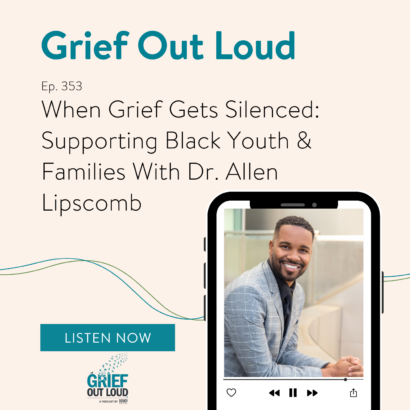
- When Grief Gets Silenced: Supporting Black Youth & Families With Dr. Allen Lipscomb
When Grief Gets Silenced: Supporting Black Youth & Families With Dr. Allen Lipscomb
May 12th, 2026 | Episode 353
Acknowledgment, validation, and curiosity – meeting grief with these three elements is crucial in creating supportive, culturally relevant grief support environments for children and adults. Dr. Allen Lipscomb has spent his career researching, designing, and implementing anti-racist interventions that directly support not just grief from death loss, but also the grief from racialized trauma experienced by those in the Black community.
Dr. Lipscomb shares his personal experiences with grief, including the death of his grandmother when he was a child and being wrongly accused of a crime in his adolescence. He also discusses the roots of his work as a clinician, researcher, and Professor of Social Work, including the culturally specific ways he engages with clients that prioritize choice and naming racism and racialized trauma that play a role in how people grieve.
We discuss:
- How childhood experiences of death, racism, and wrongful accusation shaped Dr. Allen Lipscomb's understanding of grief, trauma, and identity
- The impact of racialized trauma on how Black youth and men experience, express, and silence grief
- Why naming experiences like racism, PTSD, and loss can be profoundly important and validating
- What culturally responsive grief support looks like, including storytelling, oral histories, grief mapping, somatic awareness, and community-centered care
- How grief supporters can avoid rescuer dynamics and instead create invitational, choice-centered spaces to explore grief
- The importance of preparing mental health providers, schools, and communities to offer anti-racist, culturally relevant grief support for Black youth and families
Allen E. Lipscomb, PsyD, LCSW, Professor of Social Work, Associate Chair, Director of MSW Online Program; and Director of Minority Male Mentoring (M3) and Student Success Allies (SSA) program at California State University Northridge in the Department of Social Work. Dr. Lipscomb is a clinical psychologist and a Licensed Clinical Social Worker in the State of California. Dr. Lipscomb specializes in providing anti-oppressive and inclusive mental health services to individuals, children, youth, couples, and families of color. His areas of research are centered on the psychiatric epidemiology among racialized and marginalized individuals who have experienced trauma (i.e., complex trauma, traumatic-grief, and race-based trauma). Dr. Lipscomb has conducted numerous qualitative research studies on racialized Black identified men across the Black/African Diaspora exploring their grief, loss, and complex-trauma experiences. His pedagogy is centered on cultural anti-oppressive and clinically responsive inclusive practices with communities of color. Dr. Lipscomb maintains a private practice; conducts local, national, and international trainings; is a consultant/coach, and keynote speaker. Dr. Lipscomb has numerous peer reviewed journal articles that centers Black male grief experiences and has a published five books all centered around Black men and boys grief, trauma, and healing journeys.
Resources mentioned:
- Reframing Grief for Black Students: A Qualitative Analysis of Grief Resilient Affirming Care through Empowerment (G.R.A.C.E) Training
- My Grandmother's Hands by Resmaa Menakem
Connect with Dr. Lipscomb
Support Grief Out Loud
"The best podcast out there for grievers and those interested in death and dying or working in that field. The host is so compassionate and asks the perfect questions. The guests are always very mindful and knowledgeable. I get something new out of every episode I listen to. Would highly recommend to anyone grieving as a tool towards resiliency through a really tough time."
Show your support for Grief Out Loud® and open up more conversations about grief by donating or subscribing today. Your donations keep this podcast free from advertising and your 5-star reviews help others find us.
Grief Out Loud® is supported in part by the Chester Stephan Endowment Fund in loving memory by the estate of Theodore R. Stephan.
Dougy Center, through the Grief Out Loud podcast, is committed to learning from and sharing diverse perspectives on grief experiences and grief support. The views expressed by podcast guests are their own and do not necessarily reflect the positions of Dougy Center, its staff, or its Board of Directors.